
As part of preparations for leadership transition and institutional continuity, the Society for Peace Studies and Practice (SPSP) is pleased to introduce the Executive Summary and Executive Brief of its Maiden Five-Year Strategic Plan (2026–2030).
This Strategic Plan, provides a clear roadmap, for consolidating SPSP’s achievements and scaling its impact across Africa and beyond.
Why a Strategic Plan Now?
Since its incorporation in 2006, SPSP has grown from a Nigerian academic initiative into a continental and global peace network, with:
-
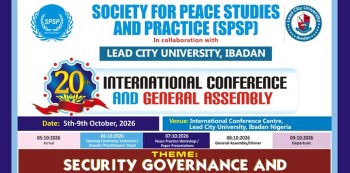
19 International Conferences convened
-
Active national chapters, including Sierra Leone and Cameroon
-
Strategic partnerships with institutions such as the United Nations ECOSOC, International Peace Bureau (IPB), and International Alert
The Strategic Plan responds to a rapidly evolving peace and security environment in Africa—marked by democratic backsliding, violent extremism, fragile governance systems, and complex security threats—while positioning SPSP for greater relevance, coordination, and measurable impact.
Vision and Ambition (2026–2030)
At the heart of the Plan is a bold ambition:
To catalyse peace for at least 5 million people across Africa by 2030 through research, advocacy, training, policy engagement, and community-based peacebuilding.
SPSP’s Theory of Change envisions an Africa where communities live in peace and harmony and are empowered to realise their full potential.
Four Strategic Objectives
The Plan is anchored on four mutually reinforcing Strategic Objectives:
-
Position SPSP as an internationally recognised peace actor across Africa
-
Strengthen strategic partnerships with security forces to integrate peacebuilding into security operations
-
Institutionalise the Body of Eminent Experts as a structured mechanism for influencing peace and security policy
-
Scale peacebuilding and conflict management interventions at community level
These objectives reflect SPSP’s unique identity as a bridge between academia, policy, security institutions, and practice.
Key Strategic Priorities
To deliver on these objectives, the Plan prioritises:
-
Revitalising membership engagement and participation
-
Expanding SPSP branches across East Africa, Southern Africa, the US, and the UK
-
Deepening cooperation with international peace actors
-
Operationalising partnerships with security agencies
-
Leveraging the Body of Eminent Experts for high-level policy influence
The Plan is informed by a candid capacity assessment—building on SPSP’s credibility, global recognition, and partnerships, while addressing challenges such as uneven branch activity, funding constraints, and impact tracking.
A Call to Members and Stakeholders
The SPSP Strategic Plan (2026–2030) is not merely a policy document. It is a call to action—inviting members, Fellows, partners, and stakeholders to collectively shape the Society’s next phase.
Members are encouraged to study the Executive Summary and Executive Brief ahead of the Scheduled Strategic Plan discussion, and to actively engage in shaping its implementation as SPSP prepares for public presentation and leadership transition on January 12, 2026.
Together, this Plan positions SPSP to emerge by 2030 as Africa’s pre-eminent network of peace scholars and practitioners, influencing policy, empowering communities, and advancing sustainable peace across the continent and globally.


















:%20A%20Framework%20for%20the%20Next%20Phase%20of%20Peacebuilding)